
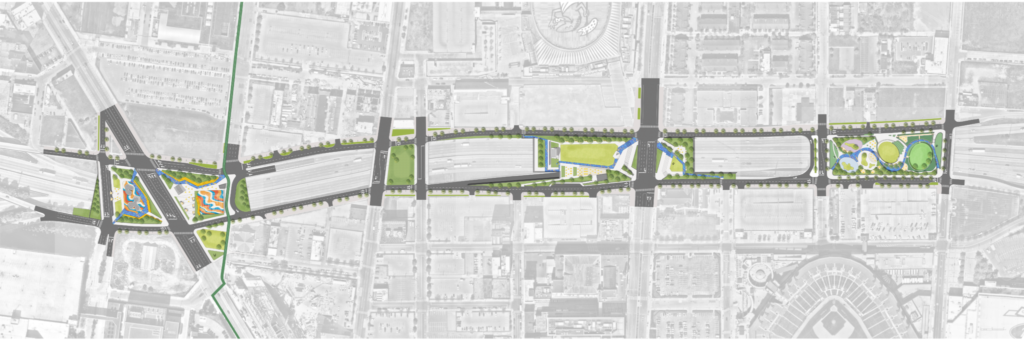
A nearly yearlong engineering study has determined that it is possible to build three deck-like land structures over sunken portions of Interstate 75, clearing the first major hurdle to fulfilling ambitious plans to reconnect neighborhoods that the highway split when it was built.
The I-75 Cap Project is led by the Downtown Detroit Partnership (DDP) with help from the Michigan Department of Transportation (MDOT) and the City of Detroit. Plans are to build three structures, or caps, over portions of the highway that dip below ground level. Planners envision a variety of community amenities for each cap, such as parks and green spaces, performance venues, public art, and reflective spaces that stretch across the mid-century highway.
The proposed caps would comprise about nine acres. The just-completed study puts the price tag for construction at around $300 million. Final design plans are expected in 2028, with construction to begin sometime after, according to the DDP.
The project plans three spans of about 1,600 feet over I-75, connecting Downtown, Midtown, Brush Park, and lower Cass neighborhoods:
- Central Cap: Planned near Little Caesars Arena, it is envisioned as an urban hub with a performance pavilion, event lawn, and outdoor cafes for citywide gatherings.
- East Cap: Near Brush Park and Paradise Valley, this cap is designed as a reflective space that honors Detroit’s Black cultural legacy, featuring walking paths, gardens, and public art.
- West Cap: Near Cass Technical High School, Wayne State University, and the University of Michigan Center for Innovation, this one is planned as a youth-focused recreation and event space with sports courts and food trucks.
The project was jump-started by federal and state grants, including a $2 million U.S. Department of Transportation Neighborhood Access and Equity grant, with an additional $4 million in federal funding lined up for the next phase of engineering.